Leadership is a Noun,
Not a Verb.

You have the title. You have the record that earned it. The question that outlasts both is who you are in the role, and what your presence does to the people who depend on you.

“I was at a crossroads, both strategic and personal. Kevin’s work went way beyond what I expected. His emphasis on values, vulnerability, and leading authentically was quite unexpected, and gave me the conviction to make some very tough calls.”

President, Hospitality

Executives come to Kevin for three reasons.

Intervention

A board, chief executive, or senior leader recognizes a performance, relationship, leadership, or organizational problem that has resisted conventional solutions.

Executives in silhouette around a boardroom table
Two executives shake hands on a staircase

Performance

A successful executive wants another level of performance, self-awareness, leadership capacity, or organizational impact.

Guidance

An executive wants a confidential, independent thought partner for consequential decisions, free of organizational politics, competing agendas, and the limits of internal relationships.


A senior advisor laughs with a colleague at his desk

“Kevin’s insight into organizational leadership is remarkable. He provided the experience I didn’t have but desperately needed in this competitive world. The quiet confidence he instilled made our entire team better in all of our roles.”

CEO, Financier

Wherever it starts, the work starts the same way.

Kevin begins with the executive and the situation in front of him, learns how that executive sees, decides, and affects others, and works from there. There is no curriculum to complete and no framework to hand over.

The engagement is built for one thing above all, a place where an executive can be genuinely candid. In most organizations no such place exists. Every conversation carries an agenda, a rivalry, or a risk. Kevin becomes the one relationship that does not.

Privacy is easy to find. Independence is rare, and it is what Kevin brings. He holds no stake in the executive’s position, carries no brief from the board, has no methodology to sell, and no internal politics to navigate.

That candor is what makes the real work possible. It is how the blind spots surface, the ones even a very seasoned executive cannot see alone and cannot afford. The symptoms a board wants gone are rarely the ones that matter, so Kevin works past the presenting problem to the pattern underneath, the pattern that follows a leader into any environment until the person changes.

The Work Begins With the Relationship.

The reasons vary, but they tend to be recognizable.

Where Expected Competence Ends and Real Leadership Begins.

Every executive needs decision making and vision setting. Deciding, communicating, thinking strategically, building teams, allocating resources, and getting things executed. Those capabilities are essential, and the work of sharpening them never ends.

Leadership sits deeper. Two executives can hold nearly identical competencies and have entirely different effects on the people around them. The difference lives in character, self-awareness, judgment, values, and the ability to create conditions in which other people become better.

Competencies improve what an executive can do. In addition to competency development, Kevin works on the person doing it, and on what that person’s presence does to everyone else.

Who You Are is the Work.

Kevin Crawford does not begin with the assumption that something is broken. Most of the executives he works with are already successful. The more useful question is whether they are performing at the highest level available to them, and whether the person they bring to the role is empowering the people around them or quietly holding them back.

There is a belief moving through the business world that leadership is something you arrive at. A promotion, a corner office, a title, and the work is considered finished. Kevin’s experience says otherwise. The person from whom leadership comes is never finished. That person is strengthened, deliberately and often uncomfortably, at the level of character, values, and judgment, the level most executives never work on.

Leadership lives wherever one person’s authentic self expression raises the performance or the potential of another. It appears at every level of an organization and is never confined to the top of the chart.
“The pressure as interim CEO was crushing. Kevin shifted how I saw the role entirely, from task management to a more purposeful leadership role. He got me through the immediate fires, but what he really did that I never prepared for was to build something that will last beyond my tenure.”

CEO, Manufacturing
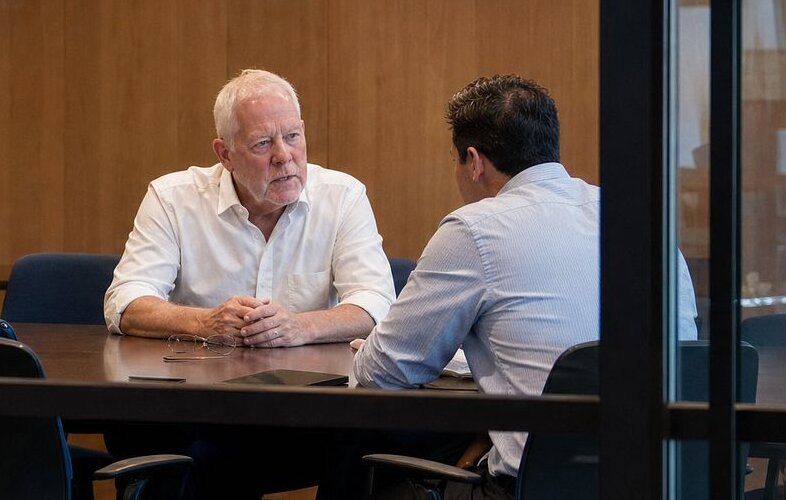
Kevin Crawford in conversation with an executive

He Has Walked the Path He Takes Executives Down.

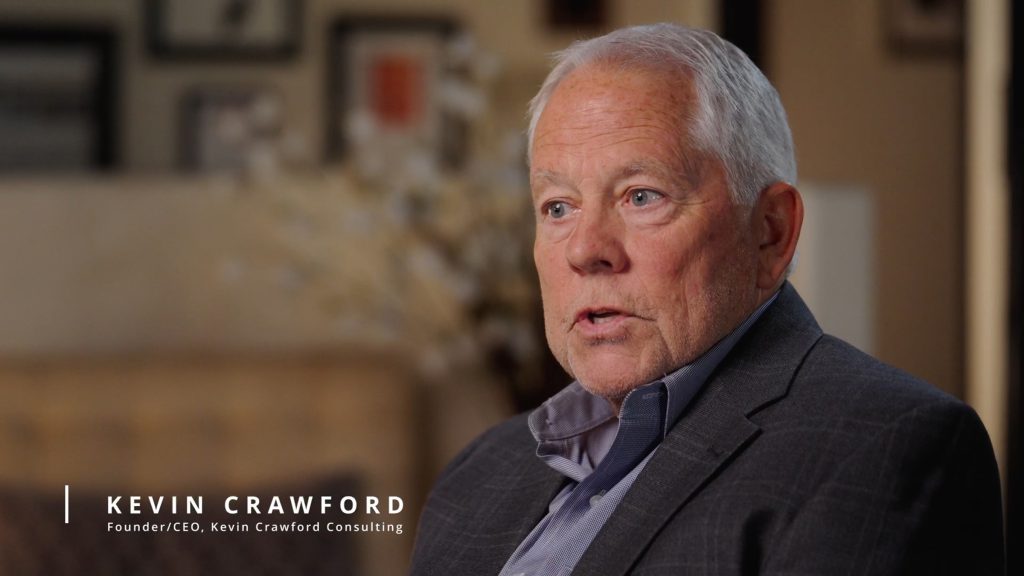
Kevin Crawford works with accomplished executives on the part of leadership that no title bestows and no competency model contains, the person behind the position. His view was formed over four decades of consequential decisions, first as a paramedic firefighter, and chief officer directing some of the nation’s largest emergencies, then as a city manager and as CEO of a global organization. He arrives without a program and works privately, one on one, on who an executive is and on the effect that person has on everyone around them.

There is no certification for what Kevin brings and no program that produces it. It was built over four decades in environments where seeing clearly and deciding well were never abstractions.

What sets Kevin apart from other consultants is notable. He has sat in the chair. He has carried the weight the executive is carrying now, made the calls, and lived with what followed. He leads with that experience, and with the relationship in front of him.

“What Kevin brings cannot be taught in a classroom or conferred by a credential. It was built in environments where the cost of underperformance was measured in lives, not quarterly results.”

Terry H., COO, Management Consulting Industry

When the Person Changes, the Organization Follows.
They Stop Managing the Inconsequential and Start Leading.

The shift shows up first in the leader. They see themselves more accurately, especially under pressure. They stop managing the room and start deciding. They build the kind of trust that makes the people around them candid, which is the only condition under which a team gives its best thinking. Judgment sharpens. Execution follows. The organization reaches a level of performance it already owned but could not access.

The work is transformational, not transactional. It changes the source, and what changes at the source stays changed. Kevin makes no promises about the bottom line. He works on what leadership actually is, and a healthier organization and a healthier bottom line follow as the byproduct.

The clearest evidence is never in the executive alone. They start to see the world around them differently. They see their co-workers in a new light. Critical thinking and creativity increases, and they stop managing the inconsequential and start leading people. That is where leadership becomes visible.
Explore podcasts and videos designed to challenge your thinking and elevate your approach to executive leadership. Discover practical ideas to strengthen self-awareness, expand leadership capacity, and unlock a higher level of performance.

Kevin Works With a Small Number of CEOs and Executive Teams.

Engagements begin with a direct conversation. There is no intake process and no qualification form. Sometimes the issue is already clear. Sometimes something simply is not working. And sometimes nothing is wrong at all, and an accomplished executive just wants to know what another level would look like. If what Kevin does is relevant to what you are facing, that becomes clear quickly.

This field is for validation purposes and should be left unchanged.

Crawford’s journey has given him a profound understanding of the pressures faced by those in top leadership positions. He recognizes that beneath the confident exterior, many CEOs grapple with self-doubt and the weight of their responsibilities. Drawing from his experiences in high-stakes decision-making as a fire chief and city manager, Crawford creates a safe space where executives can openly discuss their concerns without fear of judgment.

What sets Crawford apart is his practical approach to the psychology of leadership. Rather than relying solely on theoretical models, he draws on real-world experiences to help executives navigate complex leadership issues. This hands-on methodology resonates deeply with executives who are looking for actionable insights rather than abstract concepts.

Crawford addresses the challenge many face in receiving candid feedback. He provides a valuable external perspective, offering honest, constructive input that helps leaders identify blind spots and areas for growth. This approach enables CEOs to make more informed decisions and lead with greater authenticity.

Addressing CEO Challenges
The demanding nature of a leadership role often strains personal relationships and work-life balance. Crawford, having navigated his own transition to the private sector, guides leaders in managing these pressures effectively. He helps them strike a balance between driving organizational change and maintaining personal well-being, ensuring they can lead sustainably over the long term.

For those grappling with the complexities of leadership transitions, Crawford’s diverse background proves invaluable. He helps them navigate not just the operational aspects of change, but also the personal and emotional challenges that come with it. This comprehensive support allows leaders to approach transitions with greater confidence and clarity.

Navigating Transition and Legacy Concerns
Crawford also addresses the profound question of legacy that many contemplate. He encourages leaders to align their actions with their values, helping them build a legacy that extends beyond mere business achievements. By acting as an accountability partner, he empowers CEOs and executives to make decisions that reflect their true aspirations and have a lasting positive impact.

Crawford’s journey has given him a profound understanding of the pressures faced by those in top leadership positions. He recognizes that beneath the confident exterior, many CEOs grapple with self-doubt and the weight of their responsibilities. Drawing from his experiences in high-stakes decision-making as a fire chief and city manager, Crawford creates a safe space where executives can openly discuss their concerns without fear of judgment.

What sets Crawford apart is his practical approach to the psychology of leadership. Rather than relying solely on theoretical models, he draws on real-world experiences to help executives navigate complex leadership issues. This hands-on methodology resonates deeply with executives who are looking for actionable insights rather than abstract concepts.

Crawford addresses the challenge many face in receiving candid feedback. He provides a valuable external perspective, offering honest, constructive input that helps leaders identify blind spots and areas for growth. This approach enables CEOs to make more informed decisions and lead with greater authenticity.

Addressing CEO Challenges
The demanding nature of a leadership role often strains personal relationships and work-life balance. Crawford, having navigated his own transition to the private sector, guides leaders in managing these pressures effectively. He helps them strike a balance between driving organizational change and maintaining personal well-being, ensuring they can lead sustainably over the long term.

For those grappling with the complexities of leadership transitions, Crawford’s diverse background proves invaluable. He helps them navigate not just the operational aspects of change, but also the personal and emotional challenges that come with it. This comprehensive support allows leaders to approach transitions with greater confidence and clarity.

Navigating Transition and Legacy Concerns
Crawford also addresses the profound question of legacy that many contemplate. He encourages leaders to align their actions with their values, helping them build a legacy that extends beyond mere business achievements. By acting as an accountability partner, he empowers CEOs and executives to make decisions that reflect their true aspirations and have a lasting positive impact.